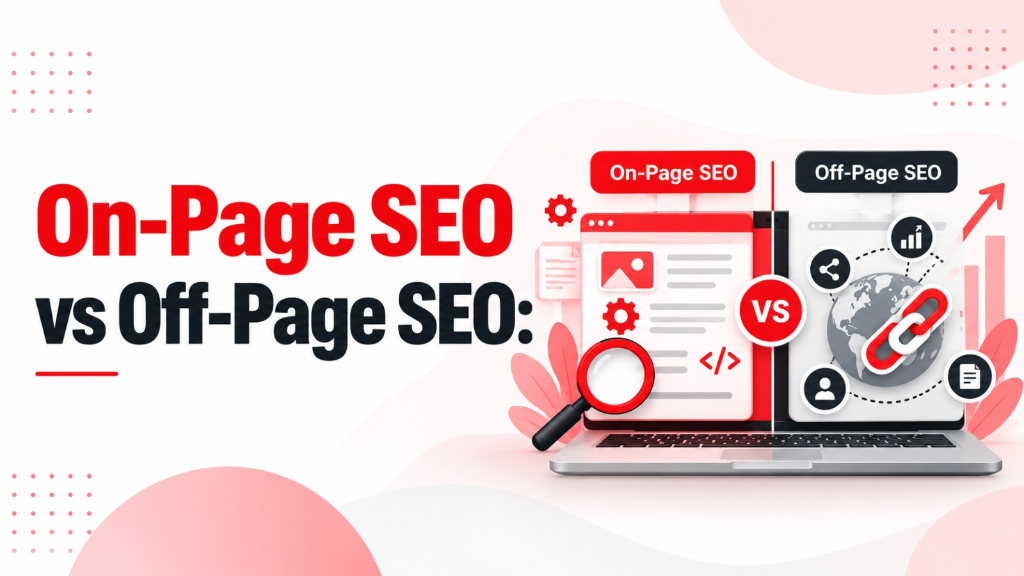
Search engine optimization (SEO) helps websites appear in search results when people look for information, products, or services online. But SEO has different parts, and two of the most important are on-page SEO and off-page SEO.
If you are learning SEO through a digital marketing course online, understanding these two methods will help you learn how websites attract visitors from Google.
On-page SEO focuses on things you can improve directly on your own website. Off-page SEO focuses on actions outside your website that help build trust and awareness. Both are useful, but they work in different ways. Let's understand the difference with simple, real-world examples.
In This Article
What Is On-Page SEO?
On-page SEO means improving the content and structural parts of a website so that search engines and visitors can understand it better.
You can control most on-page SEO changes because they happen directly on your website.
7 Important On-Page SEO Factors
1. Title Tags
A title tag tells search engines and visitors what a page is about. It serves as the primary clickable headline in search results (e.g., On-Page SEO vs Off-Page SEO: A Beginner's Guide). A clear, compelling title sets exact expectations.
2. Meta Descriptions
A short snippet (around 150-160 characters) summarizing your webpage. Search engines frequently display it beneath your title. Write clear, action-oriented descriptions highlighting what readers will gain.
3. Headings (H1, H2, H3)
Headings break content into scannable chunks so users don't have to read every sentence. Use only one H1 heading for the core topic, followed by logical H2 and H3 subheadings for supporting sections.
4. Quality Content
Quality content directly solves the searcher's query in easy-to-understand language. Explain real applications and case studies without keyword stuffing or unnecessary fluff.
5. Keyword Placement
Strategically weave your primary keyword into your title, intro, headings, and body. Include natural LSI terms like digital marketing classes, SEO training, keyword research, and content planning.
6. Images & Internal Links
Use relevant images with descriptive file names and contextual alt text. Use internal links to connect related pages—such as linking this SEO guide to your Master in Digital Marketing course page.
7. Mobile Experience and Page Performance
Your website must load fast, look clean, and be effortless to navigate across all devices. Clean UX reduces bounce rates and encourages visitors to stay longer and explore course details.
What Is Off-Page SEO?
Off-page SEO includes activities that occur outside your website to help people discover your brand and signal trust, popularity, and credibility to search engines.
Unlike on-page SEO, you do not directly control every action that occurs outside your domain. For instance, another publication might choose to link to your website organically because they find your content uniquely valuable.
5 Essential Off-Page SEO Factors
1. Backlinks
A backlink is a clickable reference from another website pointing to yours. Earning relevant editorial backlinks from authoritative domains signals trust to Google. Avoid buying links or link farms.
2. Guest Blogging
Contributing valuable thought leadership articles to reputable industry websites allows you to share expert advice and naturally reference helpful resources on your academy's site.
3. Brand Mentions
When publications or blogs discuss AGDM Academy while reviewing digital marketing training in Delhi, it builds brand authority and search discovery even without an active hyperlink.
4. Social Media Promotion
Sharing insightful blogs across Instagram, LinkedIn, and YouTube brings immediate traffic and expands organic reach to audiences who may cite or link to your work.
5. Online Business Listings & Google Reviews
For local institutes, having verified Google Business Profiles with authentic student reviews, accurate NAP details (Name, Address, Phone), and honest feedback establishes real-world local credibility.
On-Page SEO vs Off-Page SEO: Key Differences
The core difference comes down to where the work takes place and the degree of control you possess:
| Factor | On-Page On-Page SEO | Off-Page Off-Page SEO |
|---|---|---|
| Main Focus | Improving your own website & content | Building awareness and trust outside your website |
| Where It Happens | Directly on your website's pages | On external websites, directories, and social platforms |
| Content Strategy | Publishing comprehensive, user-focused guides | Earning attention via outreach, PR, and guest posts |
| Keywords | Placing target keywords in titles, headers & copy | Targeting relevant themes when promoting content |
| Links | Optimizing internal architecture & site links | Acquiring trustworthy, contextual backlinks |
| Control Level | High (100% Control) | Moderate / Low (Earned) |
| Primary Goal | Help search engines understand & rank pages | Help users discover your brand and establish authority |
*Summary: Both methods are complementary halves of a complete SEO strategy. Neither can succeed long-term without the other.
Which Is More Important: On-Page SEO or Off-Page SEO?
There is no single answer for every scenario, but there is a clear order of execution:
Build the Foundation First (On-Page)
If your website has slow page loads, confusing headings, or thin content that fails to answer user questions, promoting that page with off-page link building will only waste your time and budget. Fix on-page elements first so visitors and bots have a remarkable experience.
Amplify Authority Next (Off-Page)
Once your pages offer undeniable value, technical health, and clean architecture, pivot your energy into outreach, community engagement, and digital PR to earn authentic backlinks and scale your visibility.
How to Use On-Page and Off-Page SEO Together (Step-by-Step)
Let's say you are publishing an educational guide titled "How to Learn SEO as a Beginner". Here is how both worlds unite:
Research Search Intent
Uncover what beginners want: keyword research tools, ranking factors, and free practice platforms.
Optimize On-Page Elements
Craft a magnetic title tag, clean H2 headings, readable paragraphs, and helpful internal links.
Audit Mobile Experience
Verify instant page loading, responsive images, touch-friendly navigation, and clear contrast.
Distribute on Social Channels
Share digestible carousels and quick summaries on LinkedIn, Instagram, and Reddit marketing hubs.
Build Genuine Outreach
Connect with industry educators. If your resource delivers real value, it earns natural mentions and links.
Review Search Console Data
Track rising impressions and CTRs. Continually update the guide with fresh data and insights.
Why Digital Marketing Students Must Learn Both
Students who want to build a thriving career in SEO must understand both internal content structuring and external authority acquisition.
At AGDM Academy, students get hands-on experience running live audits, performing keyword research, writing SEO content, and optimizing live sites through our industry-leading Master in Digital Marketing (MIDM) program in Uttam Nagar, New Delhi.
In-Demand Career Opportunities in SEO
Frequently Asked Questions
Master Both On-Page & Off-Page SEO with Experts
Learn live SEO audits, keyword ranking tactics, Google Search Console, and backlink strategies with 100% placement support at AGDM Academy.